Artificial intelligence offers more than just buzzwords—it provides concrete tools for enhancing daily business functions. This article breaks down practical AI operations tailored to real-world business needs, explaining how clear, task-relevant AI workflows can improve productivity, reduce manual effort, and support safer business practices. If you’re an adult professional looking to implement AI with measurable results, this guide will clarify what to do next and where to start.
Practical AI operations focus on automating and optimizing specific, repetitive tasks within a business environment. Instead of vague promises, these operations are designed to solve clearly defined problems such as customer onboarding, workflow automation, or data context loading. The goal is to enable businesses to operate more efficiently while maintaining control and security.
Consider a consulting firm that manually processes new client information and schedules meetings. By developing an AI workflow that automatically collects client data, verifies inputs, and schedules appointments, the firm reduces errors and frees staff time for higher-value work.
AI workflows should be designed with specific business goals. This includes defining the input data, outlining each step of the automation, and integrating memory or context loading to handle ongoing interactions smoothly. For example, a workflow might include:
A retail company uses an AI agent to handle common customer inquiries such as order status or return policies. The AI accesses past order data (memory), provides instant answers, and escalates issues as needed. This workflow improves response time and customer satisfaction without overwhelming support staff.
Integrating AI into business operations requires safeguarding sensitive data and maintaining compliance. This means implementing secure data storage, access controls, and regular audits of AI decision-making processes. A well-constructed AI workflow also includes fail-safes and human oversight to mitigate risks.
Financial advisors deploy AI to analyze client portfolios and suggest actions. The workflow encrypts client information, restricts data access to authorized users, and logs all AI-generated recommendations. This approach balances AI efficiency with regulatory requirements and client trust.
Developers and businesses should leverage AI platforms that support modular workflows, memory management, and integration with existing systems. Cloud-based AI services often provide scalable infrastructure, while specialized tooling assists with workflow automation and monitoring.
A marketing agency uses an AI platform to automate campaign reporting. The platform connects to analytics tools, compiles data, and generates client-ready reports. This setup reduces manual data gathering and allows marketers to focus on strategy.
Successful AI implementation requires tracking key performance indicators (KPIs) such as time saved, error rates, customer satisfaction, and security incidents. Setting clear metrics before deployment ensures the AI workflow delivers tangible business value.
For instance, after automating a customer support workflow, measure average response time, resolution rate, and customer feedback scores. Use this data to optimize and scale AI operations.
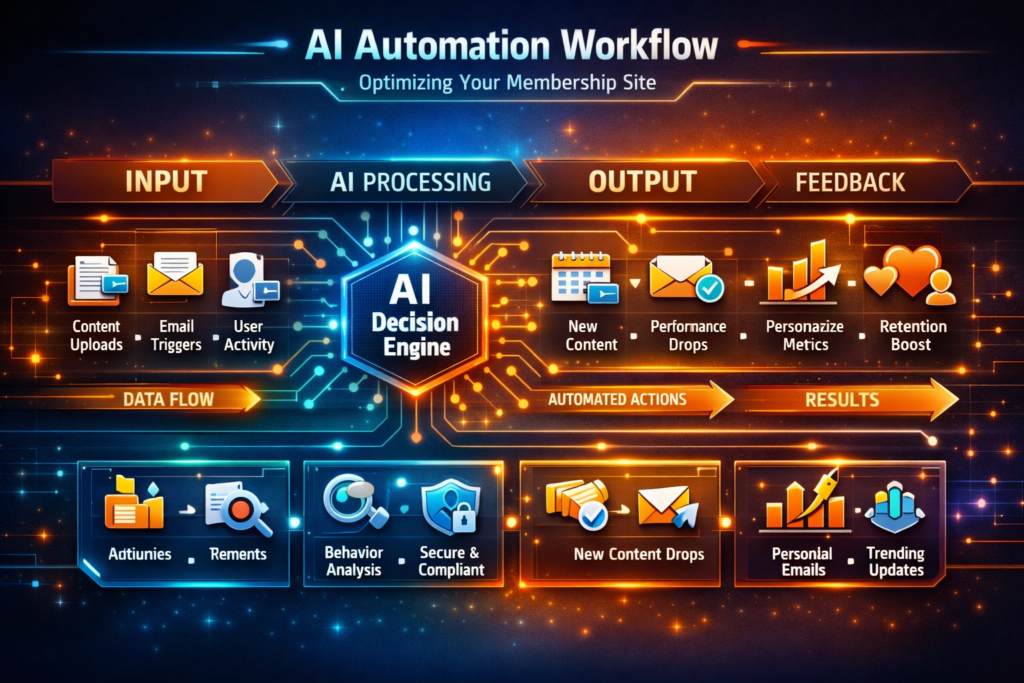
AI development is most effective when focused on practical business use cases and supported by well-designed, task-relevant workflows. Begin by identifying your business’s most repetitive or manual processes and explore how AI can automate them safely with clear metrics for success. To get started, download the sample AI automation workflow and map it to your operations. Track improvements in efficiency and customer experience, then iterate for better results.
By adopting a structured, educational approach to AI development, adult professionals can confidently integrate AI tools that deliver measurable benefits without unnecessary complexity or risk.